
A Translations Sampler!
Translations by Victoria Moul, A.E. Stallings, Dick Davis, Carla Galdo, and Others!


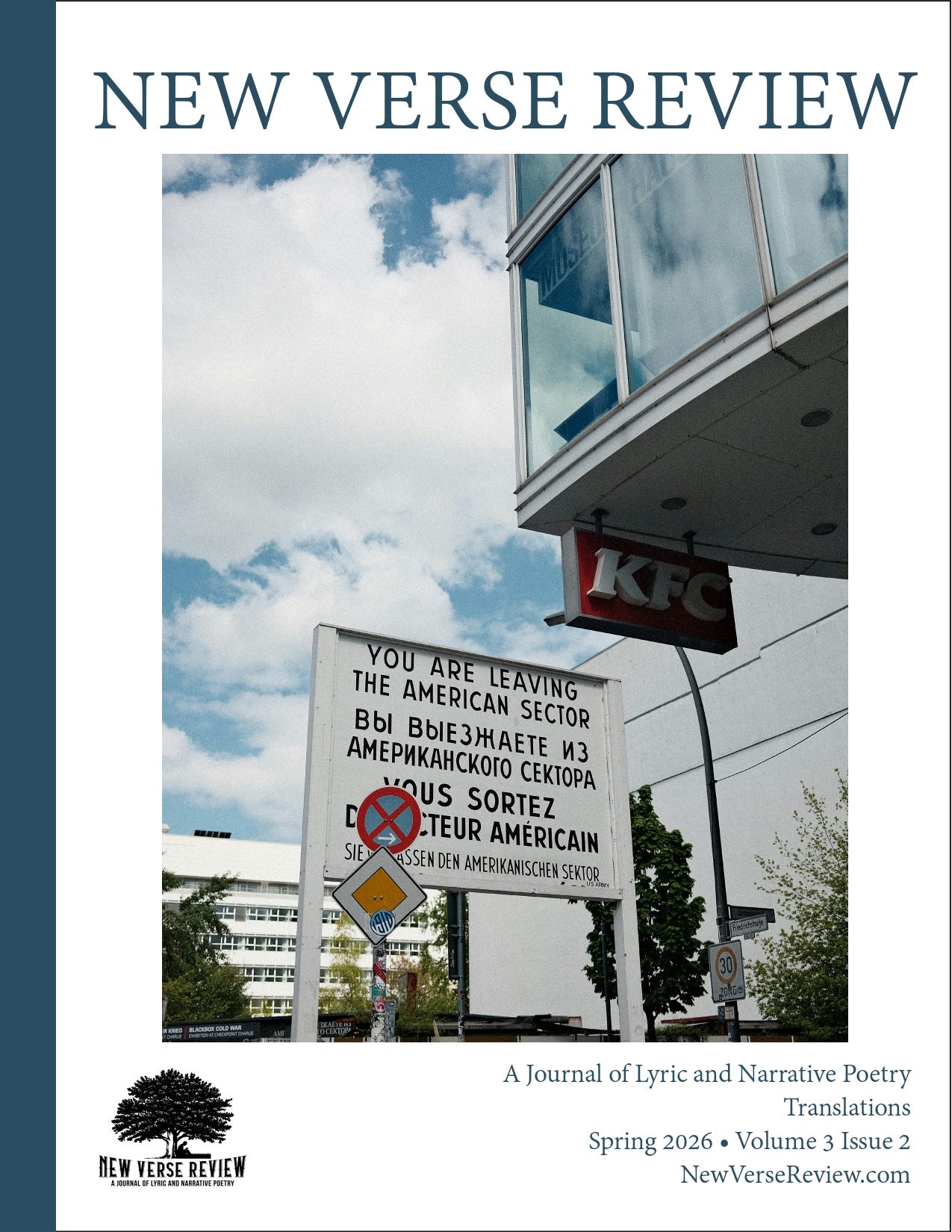
This spring, New Verse Review published a special mini-issue devoted to translations from around the world. The issue, edited by D.A. Cooper and Mary Grace Mangano, gathers translations into English from 19 languages, including Armenian, Swahili, Polish, Japanese, and Uzbek. All the poems were originally written in form, and they are translated into form as well. It makes for a unique collection of translations. Before we turn to our Summer 2026 issue, we wanted to share one more sampler from the Translations mini-issue. We also encourage you to check out the full issue here. You can find author and translator bios in the full issue.
Taline Voskeritchian and Christopher Millis
A Translation of Three Poems from the Armenian of Krikor Beledian
rocks are going to
collapse in your eye
the sea extends to your hands
breezily both salt and thirst
while the southern winds
hunt after the trees

the double-faced sea
and the earth turned upside down
skylarks at the break of day
waves moving through sky
or the passage of Shan
toward the inaudible night
the rhythm’s crescent
(7)

perhaps you cannot
live in your language without
living somewhere else

and how do you live
somewhere else without living
the strange native tongue?

I neared your body
as words verge upon the breath
verged upon your flame
(10)

o with meager words
perhaps not one syllable
flame rips you open

the languorous wind
barely flows down the river
what did you know of the light?

you’ve given your breath
to language and with that death
alone do you live
(168)
Note: Beledian does not title his haikus. The numbers at the end of each haiku indicate the page on which the haiku appeared in his book Traces of Light.
Victoria Moul
A Translation from the French of “The circular horizon” by Souleymane Diamanka
It’s snowing in my garden
Snowing autumn leaves
It’s raining at half speed
As if upon the sea.

Pens and feathers by the ton
On my garden, once so sober:
It’s raining leaves of autumn
And pages of October.

The forest now is slipping off
Her lovely umber gown
It’s raining in another clef
The snow is coming down

After drinking down
The ink of inspiration
I’ve come to read upon the ground
What the wood has written

In my garden snow
Falls like flakes of light
It’s raining in slow motion
As on the mountain height

The sun shines in my garden
And the great trees understand
I came to carve these words
In marble and in sand

In my garden burns
Like a bar of incense
A divine haze
Which scents all the world

The world of flowers, the world of beasts
From earth up to the sky
As if prayers themselves now seek
Creatures to be said by

It’s raining October leaves
Upon my calendar
The brightness of a star
Shone for you as it leaves

The wind blows in my garden
As on the ocean wild
Where the blue surge unburdens
The storm-wind’s ancient child

The wind blows in my garden
As through an empty space
Where life begins again
And far away escapes

In my garden life is good
Eternity is everyday
The breath of the tall trees make us move
But as they stay, we stay

It’s raining feathers by the ton
In my garden, once so sober
It’s raining leaves of autumn
And pages of October
A.E. Stallings
A Translation from the Greek of ““Erechtheion: A.D. 2012” by Yiannis Doukas
The flesh, and blood of flesh, and then the fly
Who lays her eggs thereon, and I compliant:
Beyond the Propylaea, I did not pry,
Faithful, ever faithful, ever client.

I found them all, I saw them there, of course,
Thin, half-clothed in drapery, and keeping
The temple up, and somehow by sheer force
Holding on to life. And there a sleeping

Bat was hanging underneath the ceiling.
I held two punctured coins, and for their sakes,
I eyed the figures curiously, appealing,
“Who knows the contagion? What makes

Us people who bow down to this disease,
In any body, mine or yours, or these?”
Note: In 2012, during the economic crisis, Greek police rounded up hundreds of alleged sex workers and gave them compulsory HIV tests; 30, who tested positive, were charged with a felony for intentionally causing bodily harm. The humiliation of the vulnerable women was captured in “Ruins: Chronicle of an HIV Witch Hunt,” a film by Zoe Mavroudi. This poem conflates the women with the Caryatids of the Erechtheion on the Acropolis, weathered women of stone who hold the temples entablature on their heads. The Propylaea, the massive entrance gates to the Acropolis, housed the altar of Hygia, the goddess of health, possibly placed there as a votive during the 5th century plague of Athens that devastated the city during the Peloponnesian war.
D.A. Cooper and Mary Grace Mangano
A Translation from the Italian of "The Sonnet" by Aldo Nove
To see a thousand-year-old form that bears
witness over centuries—in order
to say that they’ve remained like gusts of air,
so wonderful, so marvelous before their

demise, bursting with light, and held within
a sonnet—moves me, and it makes me feel
just how much history I’ve never known
and that the more I miss the more congealed

my heart becomes. I write for people who
will discuss the mystery that binds
us all to everything and nothing too:

The world’s inside a sonnet, breaking through,
but fleetingly. It mimics, in my mind,
a pathway that leads us to what is true.
Dick Davis
A Translation from the Persian of “The Empty Alleys of the World” by Khaledeh Forugh
These ancient mountain slopes are poets, even so,
Escaped now from themselves, contemporaries we know,
These ancient mountain slopes, the winds’ assault by night,
They’ve traveled here from many, many years ago.
Home to the sleepers in the cave they’re full of life
Within the empty alleys of the world they wander to and fro
And they were there, confronting Moses’ heart,
As they were passers-by of weeping Farhad’s woe.
They nourish myths, their poems are ambiguous,
They’re visible, high summits thrust up from below;
They’ve burned within themselves, they’re lost within themselves
Though lost beyond all loss they’re near at hand, and though
Their voices seethe with silence, still
The last word’s always theirs, both now and long ago;
They are the high imaginings of God
These ancient mountain slopes are poets, even so.
Carla Galdo
A Translation from the Polish of “Ash Wednesday” by Krzysztof Kuczkowski
Rend your hearts, and not your garments. (Joel 2:13)

They’ve said so much to one another, yet
he still surprises her with newness, words
leaping from his mouth like seeds from pitted plums
smelling of cyanide and violet,
bearing the sweetness of October days,
announcements of love’s end upon a cross
and of the bitter ash of last year’s palms.

They’ve said so much to one another, yet
they’ve got much more to tell, such as the tales
of how to learn from wounds, from openings,
from secret passages that must be walked
with widened eyes, in order not to lose
one’s way. Today they walked like this through snow,
led by the bitter ash of last year’s palms.

They’ve said so much to one another, yet
the most important journey still remains.
Quite slowly they prepare to leave, although
they know not the day nor the hour. Time is discreet,
master of cheerful mercy: promising
nothing, it makes a subtle English exit,
then seems to say “you see, it didn’t hurt.”

They’ve said so much to one another, yet
there are subjects which they diligently avoid.
They rarely speak of time, that it still hurts,
and that the span from man to Elohim
is not the same as that from God to man
and that the cross is closer still to us
than we are to the cross. They fear blunt nails.

They’ve said so much to one another, yet
they have forgotten more—this is a gift
that pleases them. They are like wayward children
whose parents sign them up for the first grade
and walk with them to school, so they’re not lost
along the many roads, although the parents
died years ago, and now the school is gone.
Rhina Espaillat
A Translation from the Spanish of “Clocktower” by César Sánchez Beras
This clock that never shows the precise hour
is like my soul, whose truth cannot be found;
belies, in the uprightness of his tower,
the ring of shade, the wound that girds him round.

This old clock tells the time a life ago,
regards mankind as it regards the rain,
is like Quixote bested by the foe,
wielding his lance—his wooden dream—in vain.

He scans the world—I see him—from on high,
numbers the seconds one by one, as by
his alchemy they’re turned to yesterday...

And although passers-by look up and sneer,
his round eye also marks the passing year
for those who never look, or look away.
Richard Prins
A Translation from the Swahili of “Skin” by Jacob Ngumbau Julius
When it comes to skin, time is ever crucial
The moment you begin, go get your hands full
Be sure you have a plan, haste is never gainful
Don't wait for skin to stiffen, stretch it while it's raw

Unfurl it from the middle, spread it in the open
Don't let the trees be veils, lay it beneath the sun
So that no edges crackle, grip it with less tension
Don't wait for skin to shrivel, stretch it while it's raw

Let us keep in mind the warnings I have listed
Keep an eye on time, while the leather stretches
Lizard or buffalo hides, each one has its toughness
Don't wait for skin to dry, stretch it while it's raw

Some are tougher than others, cut them so they vary,
You may be stooped over, tugging till you're weary,
Or sitting back at leisure, pulling without a worry,
Don't wait for skin to wither, stretch it while it's raw

Everything I have said, don't dismiss it, fellows
Or you will know regret, chewing your nails alone
Take command and stretch, that's the secret code
Don't wait for skin to parch, stretch it while it's raw
Shelley Fairweather-Vega
A Translation from the Uzbek of a poem from We Computers by Hamid Ismailov
The Persian term for “God” derives from a phoneme of phenomenology,
Forwarding the development of every system and epistemology.

The first occurs when its substantive circumstance emerges,
A crown of tropes bestowed by the demiurge semasiology.

An embrace of every subject in the language of functionality
is that same emanation, or a certain dichotomology.

Starting with sharpened blades, we have the scholarly operandi:
Then second and third, etc., we arrive at isomorphology.

The intentional circumstances of comprehensive dialogicity
Represented by linguists lacking the audience’s lexicology.

There’s danger in examining every defect in lost unity,
A language begun in no-min-ality is foreign pharmacology.

Nava’i has never discovered any unity of speech and truth,
Hallaj is the man we put in charge of complex linguotheology.
I especially enjoyed the translation of ‘The Sonnet.’
“The world’s inside a sonnet, breaking through, but fleetingly.” That’s brilliant.
A poem can be atomic: small, compressed, contained; but when it cracks open it releases more power than you think its size would allow.
Authors, translators and editors. Hats off to you.