
The Poet's Vision
Ryan Wilson on Poetic Hospitality

By Ryan Wilson
Editor’s Note: Ryan Wilson originally presented this essay as the Lee Endowed Lecture at The University of St. Thomas-Houston in October of 2023. We are honored to publish it at New Verse Review. It’s a work of impressive erudition, but it is also much more than that. To adapt Hölderlin: What are poets for in times of distraction? In dehumanizing times? Ryan Wilson helps us answer these perennial, but never more pressing, questions.
La poesía no quiere adeptos, quiere amantes.
—Federico García Lorca
“The poetry of earth is never dead.” So writes John Keats in his 1816 sonnet, “On the Grasshopper and the Cricket.” Recalling the dual meanings of the Greek kosmos, Robert Penn Warren tells us, “Beauty is another name for the world.” Indeed, the Beauty of God’s Creation is always calling to us. While the study of theology, especially theology in the tradition of Pseudo-Dionysius the Areopagite, beloved of both Aquinas and Dante, helps us to understand that Beauty is a transcendental attribute of God, who, as the actus purus, is the ground of all Being, it is the poet’s task to help us see this Beauty in Creation all around us, to help us love the Beauty of Creation in such a way as to point us toward its source in God. The poet’s task is to make something beautiful, to reveal, in Baudelaire’s words, “the presence of the infinite in the finite.”
The poetry of earth is all around us, and Beauty is forever calling out to us. The wind sweeping through tall grass and sounding ovations in the leaves, waves shushing each other like giddy children as they fall over one another in their race to reach shore, the wildflowers gently nodding to affirm the goodness of the sun and the rains, the moon gliding through starlit darkness like a swan through waters adazzle with diamonds’ brilliance, clouds whitely sailing lonesome through the azure ocean above, or looming gray and high-builded as limestone cathedrals—Creation cries out with myriad tongues for us to pay attention, to behold its splendor and the majesty of its Maker. And we do not. We refuse the gift; we wave away the bounty like Herods of cynicism. “What is all the world to us?”, we sneer. In this, we fail at what the Greeks called xenia, meaning “hospitality,” that hospitality between guest and host that is the fundament of all civilization. The exchange of gifts is a customary rite of hospitality. But for the inexhaustible gift of Creation’s Beauty we repay nothing, too lordly even to deign to pay attention.
“God is not mocked,” St. Paul warned the Galatians (Gal 6:7). And as the great theologian, Hans Urs von Balthasar, once wrote, “Our situation today shows that beauty demands for itself at least as much courage as do truth and goodness, and she will not allow herself to be separated and banned from her two sisters without taking them along with herself in an act of mysterious vengeance.” The individual who blinds himself to Beauty separates himself from Goodness and Truth as well, and the same is true of the culture that blinds itself to Beauty. How horrifying, then, to read Ted Gioia’s recent article describing how convenience store-owners in California now blare Mozart and Bach through their speakers to chase off loiterers. The most beautiful music ever created is now considered punishment by the youth.
“The poetry of earth is ceasing never,” Keats says, yet few today care to read it. The poet’s vision of Beauty is generally unknown, or casually dismissed with a yawn. What is the poet’s vision, and what challenges does it face? I’d like to discuss the two primary challenges to the poet’s vision, which are really the same challenge in different aspects, before concluding with a brief illustration and analysis of the poet’s vision at work.
Let us begin with two brief passages from Alexander Solzhenitsyn’s semi-autobiographical novel, One Day in the Life of Ivan Denisovich, which recounts Solzhenitsyn’s experiences as a prisoner in a Soviet gulag under Stalin’s regime. The first reveals the narrator’s strategy for survival: “The main thing was never to be seen by a campguard on your own, only in a group.” The next describes a longtime prisoner in the gulag: “During his years in prisons and camps he’d lost the habit of planning for the next day, for a year ahead, for supporting his family. The authorities did his thinking for him about everything—it was somehow easier that way.” These were the lessons of Communism: never stray from the group, never think for yourself. Your life depends on it.
With these passages, I’d like to compare a longer passage from the great psychologist Victor Frankl’s classic Man’s Search for Meaning, which recounts his experiences as a prisoner in various Nazi concentration camps.
Under the influence of a world which no longer recognized the value of human life and human dignity, which had robbed man of his will and had made him an object to be exterminated (having planned, however, to make full use of him first—to the last ounce of his physical resources)—under this influence the personal ego finally suffered a loss of values. If the man in the concentration camp did not struggle against this in a last effort to save his self-respect, he lost the feeling of being an individual, a being with a mind, with inner freedom and personal value. He thought of himself then as only a part of an enormous mass of people; his existence descended to the level of animal life.
Similarly, in Frederick Douglass’ Narrative of the Life, that great American hero describes perhaps the nadir of his enslavement thus:
Mr. Covey succeeded in breaking me. I was broken in body, soul, and spirit. My natural elasticity was crushed, my intellect languished, the disposition to read departed, the cheerful spark that lingered about my eye died; the dark night of slavery closed in upon me; and behold a man transformed into a brute!
The Communist, the Nazi, and the slave-driver all seek to debase the human person, made in imago Dei, to an animal, to strip away not only the freedoms of the individual but also the individual’s very selfhood. In each case, the individual is reduced to a part of a group, and the group is oppressed en masse in order to pursue some deranged and perverse vision of utopia.
In Orwell’s 1984, Julia advises Winston Smith: “Always yell with the crowd, that’s what I say. It’s the only way to be safe.” Poetry and the Liberal Arts, the artes liberales, or “arts of freedom,” are dangerous to totalitarian and dehumanizing regimes because they afford individuals the possibility of liberating their minds from the yelling of the crowd, from fashions and fads. The Liberal Arts can show us unapproved ways of perceiving and thinking and feeling, can remind us of the Beauty and wonder of Creation, and thereby of the Creator whose worship the tyrant would usurp for himself as Nimrod attempted to do with the Tower of Babel in Shinar. Moreover, the Liberal Arts afford the possibility of imaginative play, of finding likenesses, across times and languages and cultures, revealing the withered intellect and atrophied spirit of those who would reduce the human race by pigeonholing individuals into rigid groups based upon accidental characteristics.
Readers of poetry may find they share a great many similarities with the Lesbian Greek poetess of 600 B.C., Sappho, and with hermit poets such as Li Po, Tu Fu, and Wang Wei of the High T’ang period in China circa 800 A.D., and with the blind Argentinian Borges, with Lithuanian Poles like Czesław Miłosz and Anglican Yoruba like Wole Soyinka, with those murdered or terrorized by Stalin like Osip or Nadezhda Mandelstam, with the mad German Romantic Hōlderlin, and with victims of Franco like Lorca, and on and on forever. Readers, more generally, may find they agree on certain points with Edmund Burke and Karl Marx, Sigmund Freud and Vladimir Nabokov (who referred to Freud as “the Viennese witch-doctor”). Indeed, good readers are always finding points of likeness with those from whom they differ most greatly, both in accidental characteristics and in thought. Thomas Jefferson and Karl Marx both esteemed Epicurus, as did Vergil and his friend Horace. The ‘liberal arts’ have their name precisely because they free the individual from cliques, castes, parties of all kinds, enabling the individual to explore life’s complexities without a necessary, or foregone, conclusion. Eros calls us to seek out likenesses, wherever it may be, and whatever it may look like.
Discovering these likenesses via imaginative play (without necessarily committing one’s life to any of the various causes, or visions) allows readers to say, with Walt Whitman, “I contain multitudes.” Selfhood needn’t be a rigid and brittle thing at war with others and with reality, but, on the contrary, can contain and embrace multitudes, and in doing so can cultivate imaginative identity, which in turn facilitates a culture of xenia, of sympathy and caritas. This imaginative identity, this discovery of likeness with others, proves how pusillanimous is the Nietzschean notion that life is nothing but a struggle of the will to power. We do not wish for power to dominate those we love; we wish merely for their presence, and for more time. Tyranny is a failure of the imagination.
Indeed, it is the hallmark of oppressive regimes to suppress imagination and reason within the individual and to replace these with what Orwell calls “Groupthink,” false assertions about the nature of reality made compulsory in order to enforce allegiance to the State itself. The poet’s vision, on the other hand, has a primary allegiance to Beauty as a transcendental. Thus, in canto seventeen of the Paradiso, when Cacciaguida foretells Dante’s future exile and warns of the bestialitate of those who will seek to destroy him, he says that for Dante to maintain his honor will necessitate his remaining un parte per te stesso, “a party of yourself,” apart from the warring Guelph and Ghibelline factions (ll. 67-69). Similarly, in his Projets des prefaces, Charles Baudelaire writes, Or le poète n’est d’aucun parti. Autrement, il serait un simple mortel: “Now the poet is not of any party. Otherwise, he would be a simple mortal.” The poet’s allegiance to transcendental Beauty removes him from power-struggles insofar as he is a poet. Or, we might echo the Symposium and say with Plato that while the poet, like the philosopher, remains as a man μεταξὺ σοϕοῦ καὶ ἀμαθοῦς (204b) and again μεταξὺ θεοῦ τε καὶ θνητοῦ (202d)—“between knowledge and ignorance” and “between immortal and mortal”—and thus will likely have some sort of politics, yet his yearning for the μονοειδής, or the “One Form” that is Beauty, Truth, and Goodness, separates him from hoi eristikoi and hoi antilogikoi, the “debaters” and “contradiction-mongers” who devote themselves to winning arguments and winning power.
Of course, this devotion to the transcendent, especially to Beauty, has historically set the poet, like the philosopher, apart from the crowd. More than eighteen hundred years before Kierkegaard famously pronounced, “The crowd is a lie,” the Roman poet Horace began his ode iii.1, published in 23 B.C., Odi profanum volgus, or “I hate the profane crowd.” Roughly contemporary with Kierkegaard, Ralph Waldo Emerson writes in his 1841 essay, “Self-Reliance”:
Society everywhere is a conspiracy against the manhood of every one of its members. Society is a joint-stock company, in which the members agree, for the better securing of his bread to each share-holder, to surrender the liberty and culture of the eater. The virtue in most request is conformity. Self-reliance is its aversion. It [Society] loves not realities and creators, but names and customs.
Whoso would be a man, must be a nonconformist. He who would gather immortal palms must not be hindered by the name of goodness, but must explore if it be goodness. Nothing is at last sacred but the integrity of your own mind.
Emerson would have everyone be a poet-philosopher, and what he says is at least partly true for poets and philosophers. But he himself was far more poet than philosopher, often carried away on the wings of the daimon into rarefied error. He introduces such an error here when he claims, “Nothing is at last sacred but the integrity of your own mind.” In flight from the dangers of “Groupthink,” Emerson makes a typically Romantic mistake by reducing the sacred from an attribute of God and of a God-created sacramental reality to a quality of the individual mind. He has replaced God and Being itself with his own mind.
In this, Emerson’s Romantic retreat provides an inverted image of the totalitarian state, and his error is traceable to Descartes’ famous Cogito ergo sum. Descartes confuses the mind which knows Being with Being itself. This confusion is exacerbated by the Age of Reason, in which human identity is bound up with the capacity of the pure ratio, neglecting the intellectus and the spirit and the creaturely flesh. By the Romantic age, this retreat into the individual mind has become commonplace, even as works like Byron’s The Prisoner of Chillon reveal such a retreat to be an imprisoning of the self. As the Romantic spirit spreads across the West, more and more people find themselves imprisoned in their own minds—stalking in circles like Rilke’s panther in his cage at the Jardin des Plantes—isolated, incapable of genuine community, increasingly miserable, and, as the mind circles round and round within its confines day after day unvisited by anything outside itself, increasingly and devastatingly bored. This boredom is perhaps the defining characteristic of the modern mind, and its origin lies in a failure of xenia. Having locked all the doors and closed the curtains and turned out the lights—like adults who don’t want trick-or-treaters on All Hallows—the modern mind refuses all visitations and then laments the tedium of puttering around in its own darkness, while growing ever-more-eager for life’s alien festivities to be over and done with.
We often find such characters in Dostoevsky. For instance, we might note that his Underground Man is a character distinctly lacking in xenia: he fails miserably as both host and guest. He allows no one to visit him in his underground hovel except his servant, whom he loathes and deceives and abuses, and who loathes, deceives, and abuses him in return. When he attempts to venture out with old schoolmates, he proves insufferable to them, and they to him. When he feigns xenia, inviting the prostitute Liza to his home as if he would help her, he only makes matters worse for her. He cannot bear himself and cannot bear to change. In the opening of Notes from Underground, he says, “I am a sick man … I am a wicked man. … I refuse to be treated out of wickedness.” Why should he refuse to be treated? What is this wickedness? He aptly diagnoses himself when he says, “But man is so partial to systems and abstract conclusions that he is ready intentionally to distort the truth, to turn a blind eye and a deaf ear, only so as to justify his logic.” He cannot welcome anything or anyone because all are threats to his illusion of superiority, of mental dominance, reminders that he is not an omniscient god but a mere mortal.
Similarly, in Crime & Punishment, Raskolnikov is an exemplar of failed xenia. Possessed by the notion that he has transcended morality—as always happens when a creature mistakes himself for the Creator—he violates the most fundamental principle of xenia: as a guest of the pawn-broker Lizaveta, he murders her in her home and steals her belongings. Not long afterward, Dostoevsky writes of Raskolnikov:
A new overwhelming sensation was gaining more and more mastery over him every moment, this was an immeasurable, almost physical, repulsion for everything surrounding him, an obstinate, malignant feeling of hatred. All who met him were loathesome to him—he loathed their faces, their movements, their gestures.
It takes extreme suffering, imprisonment in Siberia, and the love of Sonia to break through the barriers Raskolnikov has erected to protect his sense that he is himself a god; the barriers he has built ultimately enslave him and gain “mastery” over him, and their collapse is necessary to humanize him. Sonia, of course, famously advises him: “Accept suffering and be redeemed by it.” To accept suffering is to welcome one’s humanity.
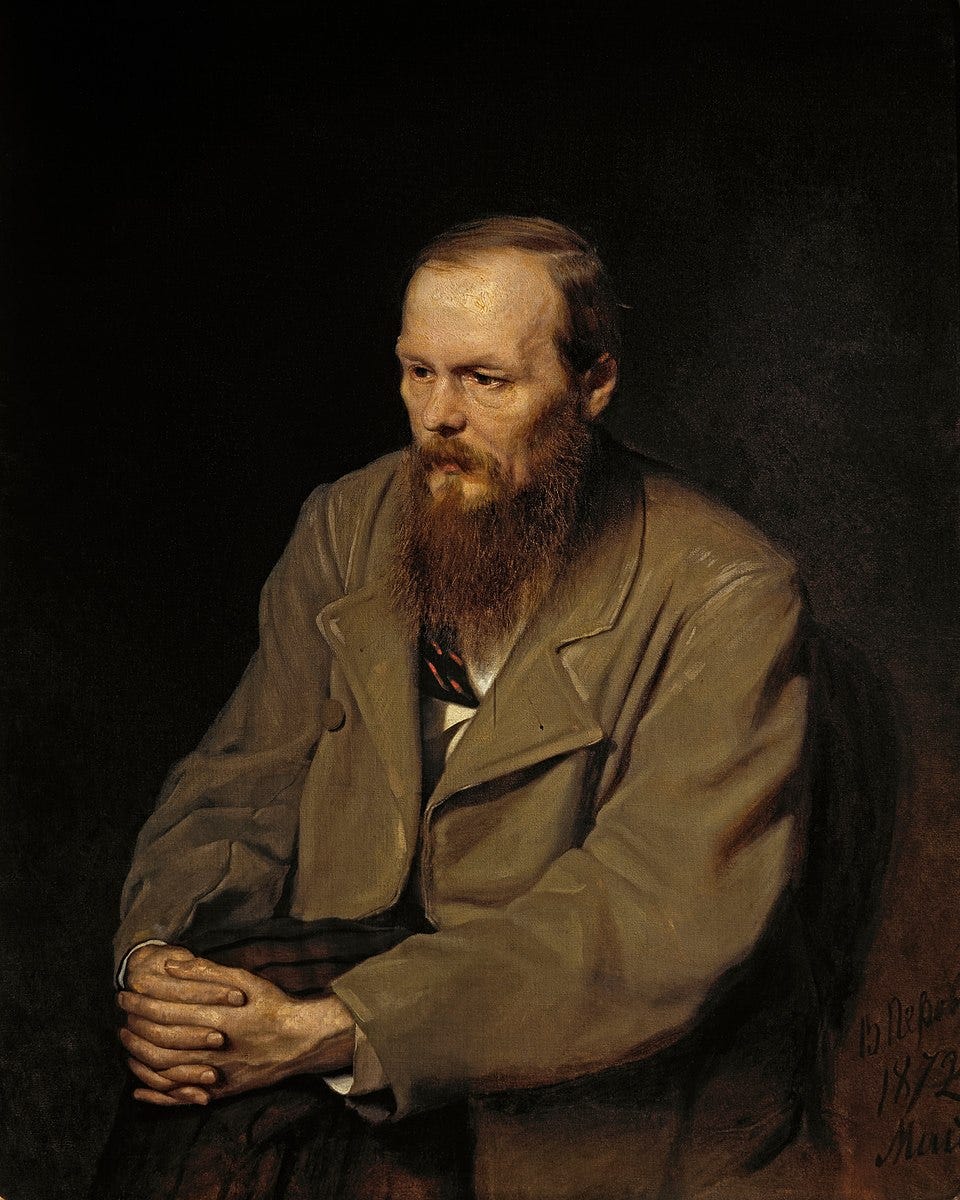
To accept suffering and be redeemed by it is, of course, also the fate of Mitya in The Brothers Karamazov. However, prior to Mitya’s imprisonment, the novel is one structured around the breakdown of xenia. Fyodor Pavlovich—father of the three brothers—fails as father and as husband; he is a poor host even to his own family. His sons, with the exception of Alyosha, are poor guests in their father’s house. All, excepting Alyosha again, show themselves failing in their role as guests when they visit the Elder Zosima at the monastery, and their behavior, informed by their lack of xenia, is so boorish it is painful even to read. And, of course, there is Ivan, another in the type of Raskolnikov, who is possessed by the idea that “all things are permitted,” that he has transcended morality, and this idea so possesses him that he cannot welcome any other, resulting, appropriately enough, with his being regularly visited by the Devil. Indeed, almost all the characters outside the monastery, and even several within, are more or less diabolical. The wisdom at the center of The Brothers Karamazov comes from the Elder Zosima, who says:
But on earth we are indeed wandering, as it were, and did we not have the precious image of Christ before us, we would perish and be altogether lost, like the race of men before the flood. Much on earth is concealed from us, but in place of it we have been granted a secret, mysterious sense of our living bond with the other world, with the higher heavenly world, and the roots of our thoughts and feelings are not here but in other worlds. That is why philosophers say it is impossible on earth to conceive the essence of things. God took seeds from other worlds and sowed them on this earth, and raised up his garden; and everything that could sprout sprouted, but it lives and grows only through its sense of being in touch with other mysterious worlds; if this sense is weakened or destroyed in you, that which has grown up in you dies. Then you become indifferent to life, and even come to hate it.
That is, when one turns from Christ or shuts out the divine in order to pursue money, or lust, or debauchery, or power, or oblivion, or whatever else, one destroys oneself. The xenia we must practice entails not merely being welcoming hosts or proper guests to each other but also welcoming the divine mystery of Being and realizing that all Being is ultimately the guest of the divine. When the latter fails, the former also fails. When we no longer see the divine in one another, we dehumanize ourselves and each other, despite our best intentions.
To consider this dehumanization further, let’s turn to Jean-Paul Sartre, the French Nobel Laureate. In Existentialism and Human Emotion, Sartre provides the fundament of Existentialist philosophy when he writes, “Existence precedes essence.” That is, the human being has no essence, no nature, that it does not itself create; thus, the human individual is self-created, and the human will is of primary importance, for it is the will which creates the self via act. While there is an element of truth of Sartre’s insistence on the importance of the will, he goes too far: he replaces God with man himself by making man the creator of himself. As Antoine Roquentin, the protagonist of Sartre’s novel Nausea, says:
My thought is me: that’s why I can’t stop. I exist because I think . . . and I can’t stop myself from thinking. At this very moment—it’s frightful—if I exist, it is because I am horrified at existing. I am the one who pulls myself from the nothingness to which I aspire …
When man replaces God with himself, Being becomes an insufferable prison without a door, and one ‘‘aspire[s]” to “nothingness.” His only consolation is his illusion that he is the maker of his own life and of his own world; his only pleasure is the dominance of his will over the world around him. Thus, as in Nietzsche, others become mere obstacles to the realization of one’s own will to power, impediments to one’s own apotheosis. Others, especially if they do not acquiesce to one’s tyrannical will, are simply reminders of one’s mortality, and thus of the absurdity of one’s pretense to the godhead, as we have seen in Dostoevsky’s Underground Man. As such, they must be despised. There can be no genuine community. From this point of view, we may understand Garcin, the protagonist of Sartre’s Huis Clos, when he famously says, L’enfer, c’est les autres: “Hell is other people”.
Having mentioned one Frenchman’s Hell, perhaps we might turn to another and briefly consider Arthur Rimbaud’s masterpiece, Une Saison en Enfer (A Season in Hell). Written between April and August of 1873, when the poet was just eighteen years old, it is the capstone to a revolutionary literary career. Already writing immortal poetry as a teenager, Rimbaud had attempted to transcend the artform and his own mortality via the dérèglement de tous les sens, “the derangement of all the senses.” That is, young M. Rimbaud sought, quite literally, to make himself an angel. The results were predictable. As Enid Starkie writes in her monumental biography:
Rimbaud had previously imagined that with his art he had soared into the beyond, but he discovered now that it was not Heaven into which he had penetrated, but Hell: it had verily been a season in Hell. It was his pride and arrogance which had brought him to such a pass and had led him into the deepest state of sin. This brought him face to face with the problem of evil. At the time of the first Illuminations [circa 1872] he had thought that the tree of Good and Evil could finally be cut down.
But this had been an illusion like all his other illusions, for the tree had sent out sucker shoots that had grown big enough to destroy him.
Discovering his catastrophic error, Rimbaud concedes: Le malheur a été mon dieu. Je me suis allongé dans la boue, or “Unhappiness has been my god. I have stretched myself out in the mud.” Attempting to transcend good and evil, and thus to usurp the godhead like Raskolnikov and Ivan Karamazov, Rimbaud merely bestializes himself in the act of defying God, and the bestial motif in his masterpiece recalls how the sinners in Dante’s Inferno are mere bestial travesties of the figures in the Paradiso. Of course, attempts to overthrow God do not overthrow God or change the nature of Being; they merely separate one from God and from all Being. To lock the door to Christ outside merely locks one inside the Hell one chooses.
Rather obviously, such attempts to transcend good and evil are attempts to restore a prelapsarian paradise via the mind. Ironically, they fall for the same trick Satan played on Eve: “and ye shall be as gods” (Gen. 3:5). Indeed, such attempts are literally diabolical. Hence, Milton’s Satan famously says: “The mind is its own place, and in itself / Can make a heav’n of hell, a hell of heaven.” And again, as Mephistopheles tells Faust in Goethe’s masterpiece, Ich bin der Geist, der stets verneint, or “I am the Spirit who always negates.” Satan would negate Being and replace it with his own illusions, his lies. And his fundamental lie is that God and Creation can be negated, that man can create himself and can create a world to replace God and Creation, that man is god. Such a temptation obviously appeals to soi-disant “creatives,” to artists, to makers, if I may activate the Greek sense of poieten, but the reality is, as Jacques Maritain notes in his “Frontiers of Poetry,” that poets are not makers so much as they are transformers of an extant Creation.
As soon as one falls for this trick of negation and retreats into the mind to “make a heav’n of hell,” one is at odds with reality, with Creation itself, and one must retreat ever farther from reality to maintain one’s illusion of power. The world takes on a dreary, menacing aspect. Everybody looks suspicious. One ceases to see anything clearly, ceases even to look too closely, as all Creation proffers a Grace one despises. And thus one succumbs to boredom, to the deadly sin acedia, to what the French call ennui. Lost is one’s sense of the connaturality with Creation, that sense of man’s fraternal relation to all God has made that led St. Francis of Assisi in his Cantico delle Creature to address the moon as sora luna, “sister moon,” and the sun as frate sol, “brother sun.” In place of this sense of connaturality and belonging, ennui sprawls out, drowsing deliciously. As Baudelaire writes in Au Lecteur, the opening poem of his great Les Fleurs du Mal:
And yet, amid the jackals and panthers, in
The throngs of vultures, spiders, vipers, apes,
And howling, grunting monsters of all shapes,
Within the zoo of our egregious sin

There’s one more squalid, fierce, in a vile robe!
Unable to act, or cry, dramatically,
Still, it would have the earth made a debris,
And with a yawn would swallow the whole globe.

Boredom!—The eye unwilling tears would smother,
It puffs its hookah, dreaming guillotines.
Reader, you know this monster, how it preens—
Hypocrite reader—doppelgänger—brother!
Boredom is the inevitable result of foreclosing on the experience of Creation and retreating into the mind, the result of failed xenia closing the door on the stranger world that brings news of its Maker.
We have seen already that the failure of xenia informs a great deal of modern literature, and the same is true of its resultant boredom. The eponymous priest of Georges Bernanos’ 1936 Diary of a Country Priest echoes Baudelaire when he tells us that “the world is eaten up by boredom,” and he himself is not immune to this boredom. He opens the novel by saying, “Mine is a parish like all the rest. They’re all alike.” Only after much suffering and self-examination and prayer does the narrator learn to see the wonder of Creation, the splendor of Being, leading him to conclude, with an echo of St. Thérèse of Lisieux’s deathbed statement, “Grace is everywhere.”
In a slightly earlier diarial novel, Rilke’s 1910 Notebooks of Malte Laurids Brigge, we find a similar struggle against boredom, this one in Paris and thus clearly echoing Baudelaire again. While the protagonist senses “the existence of the horrible in every atom of air,” he asserts early on, “I am learning to see.” For Brigge, learning to see means learning to practice xenia, learning that Creation and reality exist outside his mind and that he must allow them entrance. Rilke writes:
No, no, there is nothing in the world that can be imagined in advance, not the slightest thing. Everything is made up of so many unique particulars that are impossible to foresee. In imagination, we pass over them in our haste and don’t notice that they’re missing. But realities are slow and indescribably detailed.
The mind is no replacement for reality. Finally, Rilke closes his pseudo-novel with a retelling of the Christ’s parable about the Prodigal Son. In Rilke’s version, the Prodigal Son is a tale about a man “who didn’t want to be loved.” He runs away from home so as not to love others, and not to be loved. Rilke writes: “Not until long afterward would he realize how thoroughly he had decided never to love, in order not to put anyone in the terrible position of being loved.” More importantly, for Rilke, we are all the Prodigal Son, all running from divine Love and thus from every human love; moreover, to escape love, we flee Creation itself and retreat into the mind, closing our eyes and stopping our ears like Odysseus sailing past the Sirens.
Ultimately then, Rilke might have said with Richard of St. Victor, Ubi amor ibi oculus, or “Where your love is there your eye is.” When we flee love, we flee sight, and when we do not see clearly we do not love. By “see,” I do not intend pure sensory perception. Many have ears that can hear but don’t, have eyes that can see but won’t, and vice versa—indeed, at times, we all succumb to these failures. By “see,” I mean specifically an imaginatively-informed spiritual insight characteristic of religious meditation. Without this kind of sight, other people are not quite real, nor is one quite real to oneself. This kind of sight recognizes the limitation of pure perception, and the limitations of the seer, and makes one aware of a reality beyond perception, a spiritual reality. Seeing in this sense involves humility, or what Keats calls “negative capability.” It requires the seer to acknowledge the incomprehensible mystery of the seen and the presence of an incomprehensible level of reality.
To put down our prejudices and assumptions and see what’s really in front of us requires intense effort. In The Hound of the Baskervilles, Sherlock Holmes famously says, “The world is full of obvious things which nobody by any chance ever observes.” Most of the time we see what we want to see, or expect to see, and thus see only ourselves reflected rather than seeing the world beyond us. We stare, transfixed, at our own image mirrored in the window. Hence, in his novel Tinkers, winner of the 2010 Pulitzer Prize, Paul Harding writes, “Cease your filibuster against the world God gave you . . . Behold, and be a genius.”
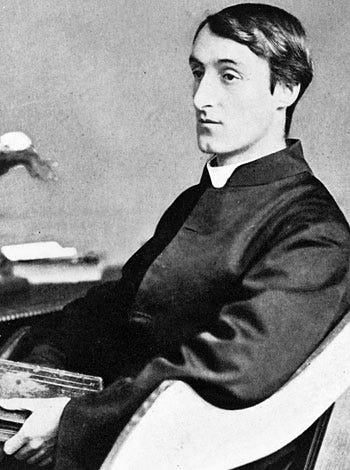
“Behold and be a genius.” To “behold” in this sense is akin to what Gerard Manley Hopkins calls “instress” and “inscape.” Each thing has its own individual inscape, its own distinctive and dynamic identity or form, and each enacts its inscape in its doings. Hopkins writes:
As kingfishers catch fire, dragonflies draw flame;
As tumbled over rim in roundy wells
Stones ring; like each tucked string tells, each hung bell's
Bow swung finds tongue to fling out broad its name;
Each mortal thing does one thing and the same:
Deals out that being indoors each one dwells;
Selves — goes itself; myself it speaks and spells,
Crying Whát I dó is me: for that I came.
To behold each thing as it “selves” and to sense its inscape is what Hopkins calls “instress.” This kind of sight transcends the perception of the material entity to recognize in the “inscape” of each thing its response to God’s call, its response to the Logos that is the ground of all Being. Thus, instress allows the beholder to see not merely a given material entity but also, as Dostoevsky’s Elder Zosima has it, how that material entity is “in touch with other mysterious worlds.” To see in this way is akin to the movement of Eros as represented by Diotima’s staircase in Plato’s Symposium: one sees both the individual creature and also a glimpse of the Creator’s divine Beauty at once.
This is, properly, the poet’s vision. It requires xenia of the poet, who must put aside preconceived notions and systems of thought and welcome the stranger that is each being and each moment, recognizing that these strangers may be, like the strangers visiting Lot in the city of Sodom, angels, messengers bringing news of God. It requires love of the poet, who must desire the presence of the phenomenon and of the moment so intensely as to behold its inscape in the revelation of instress. It requires humility of the poet, who must recognize the ultimately unknowable mystery that informs the entity and the moment and the poet himself.
The utilitarians and totalitarians seek to destroy this vision because it calls us beyond money and power. Those beset by the diabolical flee this vision because it would humble them, and their psychological response to the utilitarians and totalitarians is to exalt themselves in order to maintain their ego’s sense of value as more than a consumer or a statistic. Of course, ironically, it is this very diabolical empowerment of the self that leads to ruthless totalitarianism: Captain Ahab, in Melville’s Moby Dick, illustrates precisely this point, showing Emerson’s self-reliance taken to its extreme. And yet, for the poet qua poet, “It is always morning in the world, in spite of history,” as the late Derek Walcott writes. The poet’s vision, his proper vision, is always possible, always available for those who seek it. As our Lord says in Matthew 7:7: “seek and ye shall find.”
Father Hopkins, in his great poem “God’s Grandeur” illuminates this theme.
The world is charged with the grandeur of God.
   	 It will flame out, like shining from shook foil;
   	 It gathers to a greatness, like the ooze of oil
Crushed. Why do men then now not reck his rod?
Generations have trod, have trod, have trod;
   	 And all is seared with trade; bleared, smeared with toil;
   	 And wears man's smudge and shares man's smell: the soil
Is bare now, nor can foot feel, being shod.

And for all this, nature is never spent;
   	 There lives the dearest freshness deep down things;
And though the last lights off the black West went
    	Oh, morning, at the brown brink eastward, springs —
Because the Holy Ghost over the bent
    	World broods with warm breast and with ah! bright wings.
“Nature is never spent,” Hopkins says, “There lives the dearest freshness deep down things.” Indeed, that freshness is the inscape, the selving of each thing in response to God’s call and behind that selving the ever-fresh call of God that creates and sustains all Being.
As I have said, the vision of the inscape is akin to Diotima’s staircase from the Symposium, and as Diotima speaks of an ascent from the particular to Beauty itself so the inscape has an element of verticality to it: each thing selves itself and in doing so points upward toward God. Thus, in poems that capture the inscape, there must be an element of verticality, of meaning that is not direct and linear as in prose but rather is indirect and revelatory, an element of ceremony. No modern poet captures this verticality better than Father Hopkins.
A few prefatory remarks: First, Hopkins was a gifted scholar of Latin and Greek as well as of Welsh, and he often brings out “the dearest freshness deep down things” by activating the etymons of his words so that the words mean one thing on the surface while also having a deeper level of signification that participates in patterning his poems, aesthetically embodying the ordering of the Logos visible only to those who “have eyes to see.” Secondly, this poem belongs to a tradition of Christian artwork rendering the dove and the olive sprig. To appreciate Hopkins’ poem, it will be helpful for us to recall a few passages from Scripture with an eye toward exegetical typology.
The first passage occurs in Genesis 8:11, the tale of Noah’s ark: “and the dove came back to him in the evening, and lo, in her mouth a freshly plucked olive leaf; so Noah knew that the waters had subsided from the earth.” The second occurs in Matthew 3:16 when Christ is baptized by John: “And when Jesus was baptized, he went up immediately from the water, and behold, the heavens were opened and he saw the Spirit of God descending like a dove, and alighting on him.” Thus we see the dove as the Spirit of God, and we find that the Spirit of God brings Noah peace when the dove delivers the olive branch after the Flood. We can then group these passages with Genesis 1:3, in which we find the Spirit of God “broods” on the waters, as a bird like the dove broods upon its eggs. The Holy Spirit broods on the waters and, in a sense, hatches the cosmos out of chaos; the Holy Spirit brings peace to Noah (and by extension to all within the ark of the Church); the Holy Spirit descends upon Christ at His Baptism along with God’s words, “This is my beloved Son, in whom I am well-pleased.” Finally, to return to the olive, let’s consider Exodus 27:20: “You shall order the children of Israel to obtain pure oil pressed from olives for the light, so that a lamp may burn continually.” The continually burning light for Israel is to be from “pure oil pressed from olives,” a figure for the peace of the Holy Spirit that is to be the continually burning spiritual light of the faithful.
Now let’s return to Hopkins’ poem. First, we might note that “oil,” ending line three, derives from the Greek elaion, meaning “olive tree”; that “toil” in line six derives from the Latin tudicula, meaning “a mill for crushing olives”; and that “smeared” in line six derives from the Old English smerian, meaning “to anoint with oil.” That is, the octave of this sonnet concerns itself with the olive, the sign of the Holy Spirit’s peace. However, as lines five through eight make clear, this peace is sorely lacking in the modern world. Why? Man has trampled both nature qua nature and his own nature. A key word is “trade,” meaning here something like what Wordsworth means when he writes “The world is too much with us, late and soon, / Getting and spending, we lay waste our powers.” The poet’s vision has been trampled by materialism, mercantilism, and consumerism. And I say “trampled” pointedly, for “trade” shares an etymon—the Old English tredan—with “trod”: when Hopkins writes “Generations have trod, have trod, have trod,” he not only brings out the dreary repetition of toil but also points up how trades themselves, when worked for the world rather than for God’s glory, can tread down the individual’s ability to perceive inscape. Thus, when we see that “all is … smeared with toil,” we see that all is not anointed with the chrism of olive oil but with the work of crushing olives, work that aims at peace but does not obtain peace itself. Mercantile trade and manufacture have separated us from the generative power of Creation’s Beauty which would lead us toward the Creator’s peace: “the soil / Is bare now, nor can foot feel, being shod.”
And yet, as the poem opens, “The world is charged with the grandeur of God.” Here, “charged” has several significations. First, we might say the world is “charged” as in “burdened,” from the Latin carrus, meaning a two-wheeled wagon for carrying burdens and punning on the Latin carus meaning “beloved.” The world is burdened with being beloved of God in the sense that, while Christ says His “yoke is easy and [His] burden light,” yet many will not take it up, for God’s grandeur is not man’s own. Secondly, “charged” suggests “accused,” as when one is “charged” with a crime: the “grandeur of God” reminds us of our sinful and fallen nature. Next, “charged” suggests “demanded payment of,” as when we are “charged” for a purchase: “God’s grandeur” demands we pay attention and pay worship to Him. And finally, “charged” suggests the electrical charge: the world is made electric with God’s grandeur. Note the verticality. Hopkins means all these things at once. Their significations are complementary. We might paraphrase them as follows: “The world is made bright with the creative energy of God’s grandeur, which demands we pay attention to its splendor, and, when we behold this splendor, we become aware of our fallen state and are faced with the task of taking up our crosses and following the Creator whose radiant Creation is a sign of His love for us and a token by which we may know Him.”
Moreover, the grandeur of God “will flame out, like shining from shook foil,” providing an image of goldfoil being shaken and giving off light like jewels that “flame out.” The grandeur of God shines out, flickers through all creation. And perhaps there is a secondary meaning of “foil” as “foe,” suggesting that God’s grandeur “shakes” or “escapes” the great foe, Satan. Next, the grandeur of God “gathers to a greatness, like the ooze of oil / Crushed.” If we recall that “ooze” comes from the Old English wase, meaning “mud or mire,” then we see in these lines the “mud or mire” being crushed from the olive to reveal the “oil,” or chrism; figuratively, the material is distilled into the sacred, the Adam gives way to the Christ. This, Hopkins tells us, is always happening. God’s grandeur is always flickering through Creation and revealing the sacred, and we are charged with seeing it, but we too often fail to do so, blinkered by our trades and our utilitarian daily concerns.
Nonetheless, despite our failure to perceive God’s grandeur, “nature is never spent.” Though we close our eyes to God, He does not go away. All we have to do is open our eyes, and we will find “There lives the dearest freshness deep down things.” Though now, the sun is going down—though now time is passing and we are moving toward death both physically and perhaps even spiritually—yet on the horizon, “at the brown brink eastwards,” the new day and the new life are coming, and hope “springs.” Why? Because the Holy Spirit yet “broods” over the “bent / world.” The dove of the Spiritus Sancti is still creating, still bringing forth new life, still offering us the olive of peace if only we will welcome the Spirit and receive it. Though we inhabit a “bent world,” a crooked and perverse world, a world imperiled by utilitarianism and totalitarianism and diabolical attempts to usurp God’s throne, a world beset by and besotted with Pride, yet over us still the Holy Ghost “broods with warm breast and with ah! bright wings.”
When Plato, in the Symposium, defines poetry as τὴν μουσικὴν καὶ τὰ μέτρα (205c), he teaches us a great deal. His μέτρα, which may be translated as either “meter” or “rhythm,” belongs to the quotidian temporal realm of Khronos. On the other hand, Plato’s μουσικὴν, or “music,” must be understood as a Beauty derived from the supernatural Muses. Thus, we see that Plato’s definition suggests the presence of the metaphysical in the physical, of the supernatural in the natural, and of the eternal in the temporal: the poem is a conjunction of worlds in a magic moment of intersection, a moment belonging to a kind of time that differs from Khronos, belonging to what the Greeks called καιρός, or “timeliness.” Poetry can help us behold this conjunction of the infinite in the finite, which, though we may not always see it, is always present. Great poems, even by those who reject Plato and reject the Catholicism of Hopkins, by poets who reject all notions of divinity, have this same quality of vision, and necessarily so, for all poetry and all arts originate in Memory. Whether we say with the ancients that Mnemosyne is the mother of the Muses or whether we say, as St. Augustine does in his Confessions, that Memory abuts the divine, the Memory, with its adjunct, the Imagination, testifies to the presence of Spirit within the human body, of a stranger world within and also beyond the material world, of an immanent and transcendent reality. For this reason, the object placed into the context of a poem, like the image placed in the context of a canvas, is itself and is something else; it becomes a symbol. To behold the symbol in the poem or the work of art may help us to glimpse the stranger world within persons and things outside the context of art, and within ourselves. To see in this way is to see that Being itself is a miracle, and that all Beings are wonders. Let us extend to all wonders, including ourselves, love and welcome.
Ryan Wilson was born in Griffin, GA, and raised in nearby Macon. His most recent books include: In Ghostlight: Poems (LSU, 2024), Contemporary Catholic Poetry: An Anthology (Paraclete, 2024), co-edited with April Lindner, and Proteus Bound: Selected Translations (Franciscan UP, 2021). His work appears widely in periodicals such as 32 Poems, First Things, Five Points, The Hopkins Review, Image, The New Criterion, The Sewanee Review, and The Yale Review, and has been anthologized by Best American Poetry, Christian Poetry in America Since 1940, Poetry Daily, Verse Daily, and others. He teaches in the M.F.A. program at The University of St. Thomas-Houston.
If you're moved by this essay, I highly recommend Ryan Wilson's How To Think Like a Poet! https://www.wisebloodbooks.com/store/p97/How_to_Think_Like_a_Poet%2C_by_Ryan_Wilson.html
Great piece. I thought of Chesterton throughout, a new treasure trove of whose writings is available in Dale Ahlquist's "alternative autobiography of Chesterton, I Also Had My Hour.