
The Meter Makers
Poems From a Workshop in the History of English Prosody

How the Monday Evening Meter Makers Began
Or, Spenserian Stanza and other Forms that Require Wrangling
It began on Zoom.
In October of 2024, I was listening to The Critical Path, a poetry symposium that began in 2010 when Jan Schreiber and David J. Rothman gathered a group of poets and scholars to share their current prosodical interests in the form of essays around a table. (The Symposium originally met in person, in Gunnison, Colorado, but that is a different story.) As the proverb says: Iron sharpens iron, and this has proved true every year during the presentations and discussions.
While the audience was listening to David J. Rothman’s presentation, I posted a link in the chat to the book that I co-authored with him: Learning the Secrets of English Verse: The Keys to the Treasure Chest (Springer, 2022) and a discount code. Several audience members responded to my “chat.” They expressed interest in the book and in its curriculum, which is unique (as far as I know). We present meter and form in English poetry as it occurred chronologically, and we use model poems by master poets and students, scanned with commentary to instruct teachers and students using the textbook. (This curriculum is based on a class that David J. Rothman took at Harvard with the late, very great Robert Fitzgerald, entitled “Versification.” The pedagogy, a tried-and-true method that both Rothman and I use, involves models and scansion. Loads of scansion.) The curious folks in the Zoom chat wondered if they could work through the book alone. “Yes,” I said, “but you will learn more if you have an instructor and a group.” I knew this from personal experience. When I was an undergraduate (back when dinosaurs roamed the Earth), I tried to work my way through Lewis Turco’s “An Introduction to Poetry Through Writing” on my own. I learned a lot, but I longed for other writers to share the experience. A writer can only progress so far without readers. So, I found myself offering to work through the book chapter by chapter with them.
What a formidable group of poets they are! Each was already a published poet and fully committed to writing verse, and each was interested in learning more about meter and form. We began meeting every Monday evening on Zoom. I did not need to lecture about the information in the chapter because these poets were highly motivated to study. Each week, they brought their questions and their scanned exercises. We spent our time discussing each scanned poem, pointing out spots where the draft didn’t adhere to the rules of form or spots where the poem didn’t scan correctly. The primary goal was to ascertain whether the exercises stuck to the rules of the form. These were low-stakes exercises. This was not an accredited course that required grades. We were not trying to write the Best Modern Sonnet or the Most Spectacular Quatrains in English. This was not a contest; there were no prizes, save the joy of writing verse. We were diving deep into meter and form and exploring its possibilities.
And, yet…each week I was astounded at the exercises these poets produced. I write this knowing that some of those exercises have already been revised, submitted, and published!
The pedagogical premise of Learning the Secrets of English Verse is that verse is an art form. Like learning to play the piano or to draw, a teacher can instruct a student in the basic principles of the form. Nota bene: students can learn to write verse, but that does not turn them into poets. That comes from years of reading, writing, and revising.
Why am I writing about this group of Monday Evening Meter Makers? I have taught this curriculum in this way for over twenty years to high school students and college English majors. It works well for those new to poetry, even ninth graders who have little to no interest. It is effective for undergraduate English majors who think they do not need instruction in meter to write a poem that will usher in world peace. But this class was the biggest surprise of all. Remember, this group was comprised of working writers, editors, and academics who were already damn good poets. Working through this curriculum offered them the tools to refine their good exercises into smartly crafted, syntactically and semantically clear, highly polished poems. I believe they would agree.
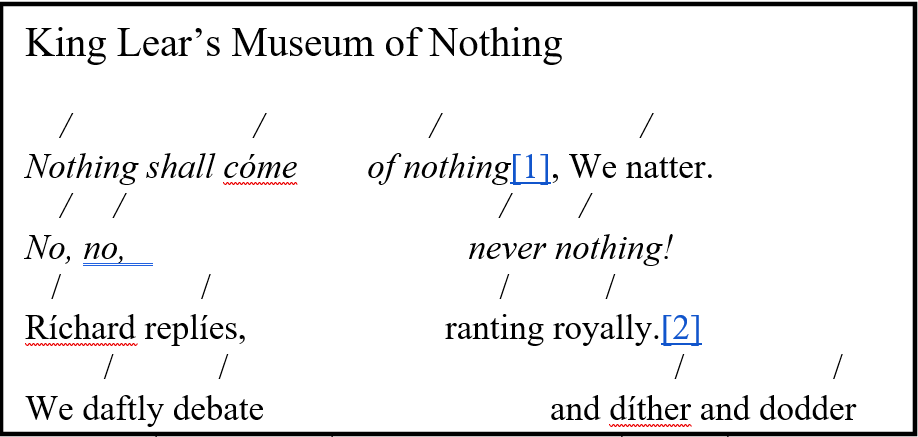
Continue reading and you will see the transformation for yourself. The pdf below contains six poems, one from each of the six poets in the workshop: Dr. Brian O’Sullivan, Mary R. Finnegan, Christiana Doucette, Chelsea McClellan, Craig Cowden, and Dale Schellenger. The poems are in alliterative verse, ballad meter, couplets, Venus and Adonis stanzas, Spenserian stanzas, and ottava rima. The poets provide an early exercise draft of their poem scanned with side notes, a final unscanned poem, and a note about their process. Writing verse is a process. Sometimes difficult, sometimes surprisingly easy. For me as a teacher and as a poet, this is the best curriculum and method I know of.
Come as you are. All are invited to this party!

Susan Delaney Spear is the author of two collections of poetry: Beyond All Bearing and On Earth..., the 2025 American Legacy Book Award for poetry/religious. She is the co-author, with David J. Rothman, of Learning the Secrets of English Verse, a poetry textbook that teaches meter and form. She lives and writes in Tampa, Florida. You can find her at www.susandelaneyspear.com.
 | A guest post by
|
Thank you for the education here, Susan!